
150-E / 150-B Stiffness Tester
- Brand
- TABER
- Model
- 150E/150B
- Origin
- USA
- Industries
- Paper, cable, printing
Features
High precision with good repeatability.
The TABER® V-5 Stiffness Tester 150 evaluates the stiffness and resilience (resistance to bending) of materials up to 10,000 Taber units. It measures accurately, to within 1%, on samples 0.1–5.5 mm thick. Materials include paper, board, plastics, metals, textiles, rubber and cable.
Description
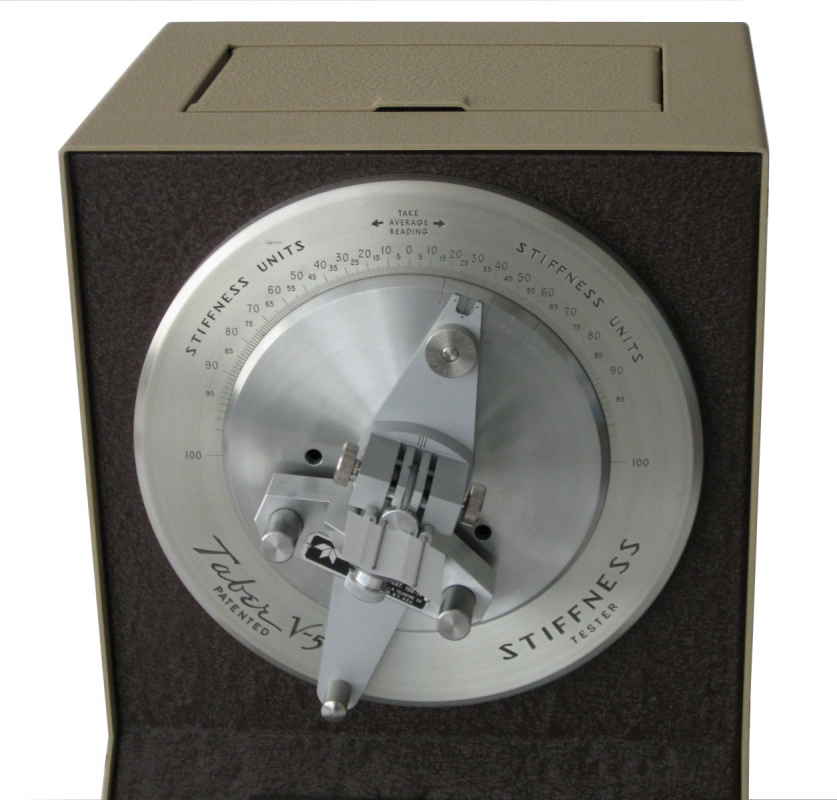
The TABER V-5 Stiffness Tester uses a two-way pendulum measuring system. Accurate and sensitive, it is an important instrument for measuring the stiffness and elasticity of materials. Nine ranges allow it to measure everything from very soft materials (such as cellophane or thin metal foil) to very stiff items (such as plastics).
For ranges 2–9, the sample is held in a clamp on the pendulum. The lower face of the clamp jaws is at the pendulum's centre of rotation.
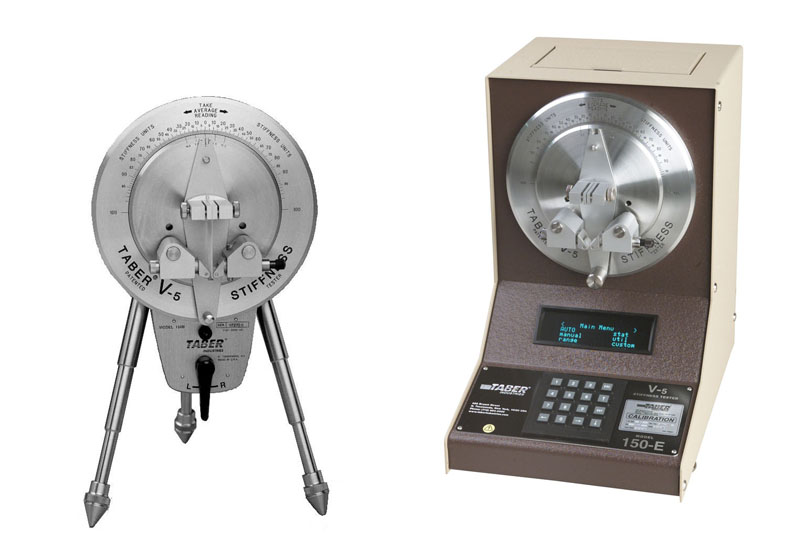
Both clamp jaws are adjustable, so the specimen can be centred precisely whatever its thickness. This fixes the test length and bending angle, giving accurate, repeatable results. Force is applied to the lower end of the specimen by a pair of rollers. The rollers are mounted on a driving disc behind the pendulum, which pushes the specimen away from vertical. As it deflects, the specimen exerts a torque on the pendulum. When the pendulum mark lines up with the driving disc mark (7½° or 15°), the reading is the stiffness value shown on the dial at that moment. The final reading depends on the range selected and its scale factor. The instrument shows the torque applied to the specimen (gram-centimetres).
Range weights can be added to the pendulum to suit materials of different stiffness. For extremely light, soft materials, a compensator weight is fitted to the top of the pendulum. The 500, 1000 and 2000 unit range weights fit to the bottom of the pendulum and are needed for stiffer materials. The optional 3000 and 5000 unit weights are needed for ranges 7, 8 and 9.
Many customers also use the TABER V-5 Stiffness Tester to evaluate the stiffness of wire and cable. The clamp has a "V-notch" for this test. Samples 70 mm long and 3–8 mm in diameter are recommended; place them carefully in the centre of the notch without crushing them. Cables under 3 mm are best placed in the flat area of the clamp. Avoid curved samples, as they can interfere with the set-up and measurement. Results of this test should only be used to compare different batches or materials.
Models
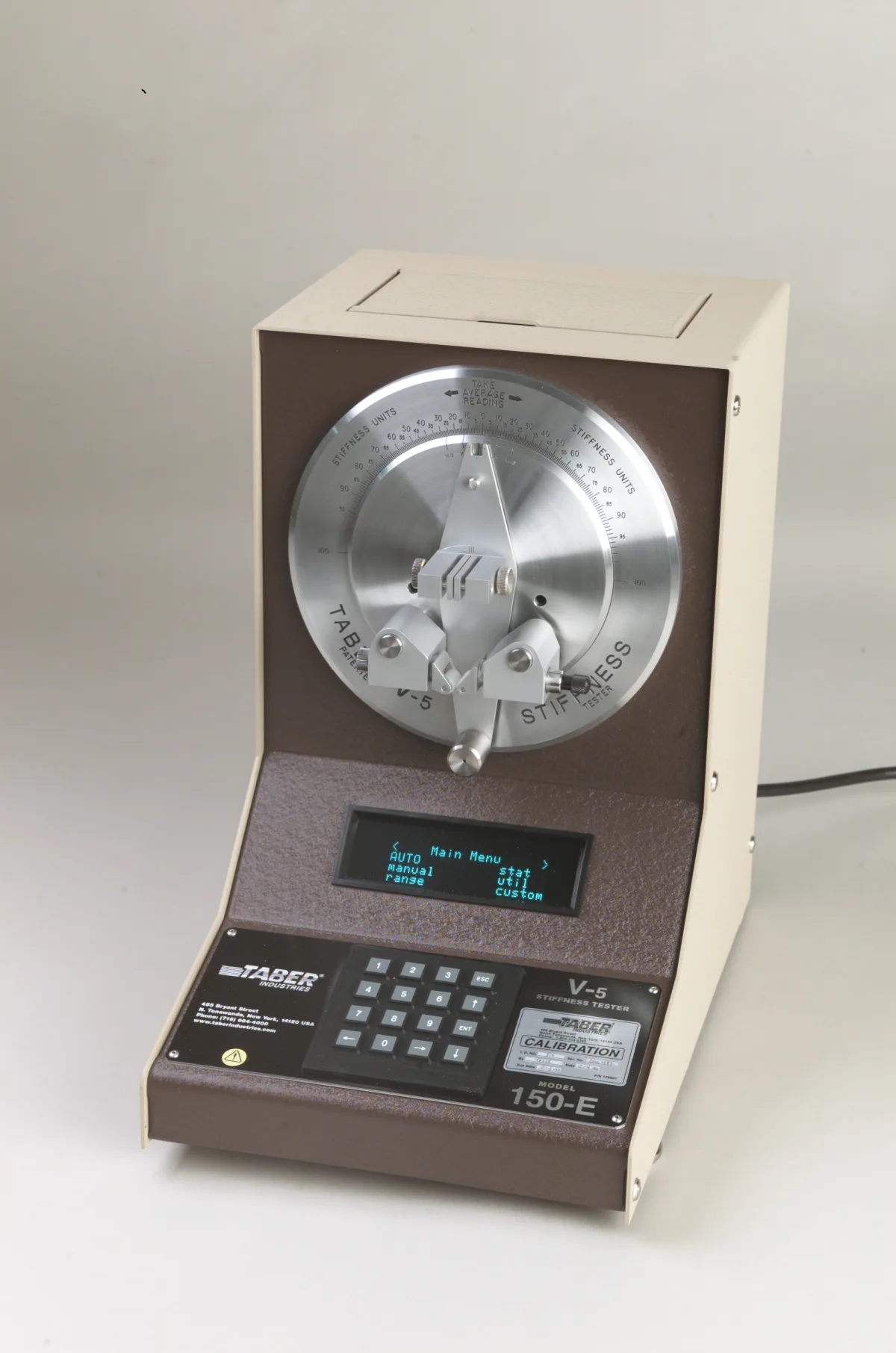
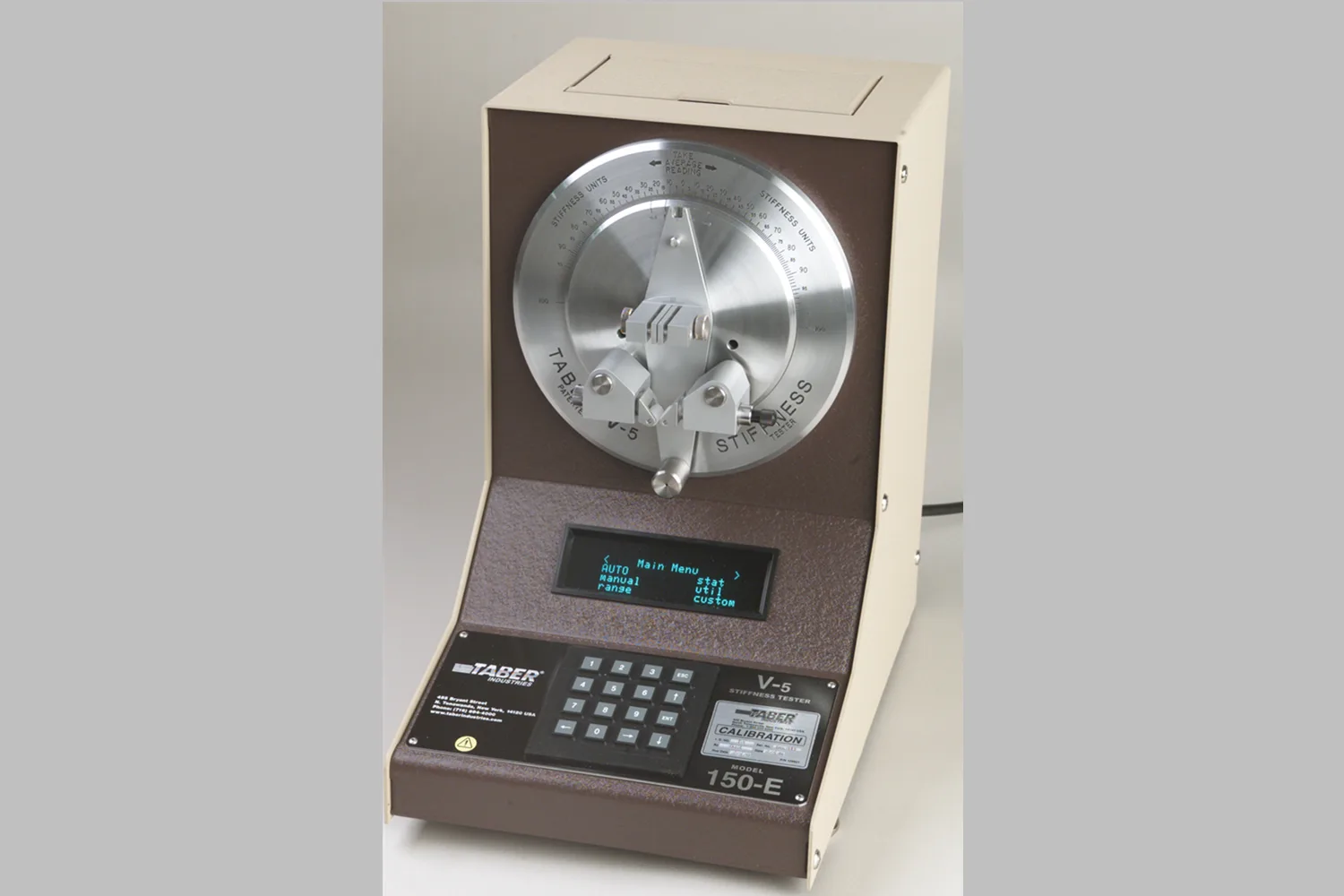
Taber Stiffness Tester – Model 150-E (115/230 V, 50/60 Hz)
The 150-E has an on-board computer that calculates and records test data automatically. It works out the stiffness value from the selected range, so there is no need to multiply by the scale factor by hand. It can also calculate the mean, standard deviation and maximum/minimum. Using a 16-key keypad, the operator selects the direction, angle and number of deflections. The instrument can also be run in manual mode, like the Model 150-B.
With the optional output port, test data can be printed or downloaded to a PC. Up to 1000 readings can be stored.
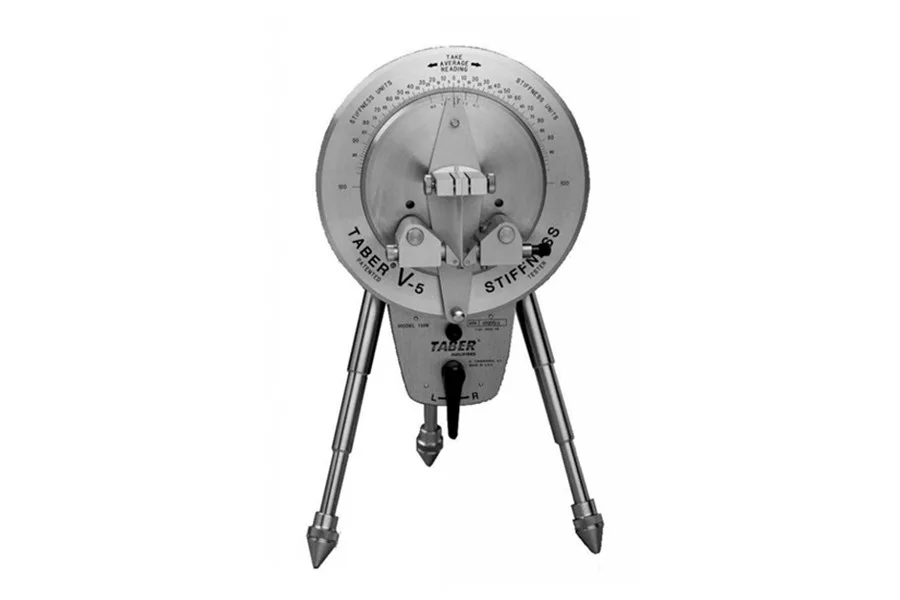
Taber Stiffness Tester 150-B (110 V, 60 Hz) – the 150-B is a manually operated instrument based on the TABER V-5 Stiffness Tester, mounted on a tripod base. It is light and easy to carry. The electronics are sealed in a sturdy housing. With the 150-B the user records stiffness readings by hand, averages them and multiplies by the scale factor.
Note: TABER supplies a transformer (220 V / 110 V) for 220 V operation.
Evaluation
After deflecting the material 15° (or 7½°) to the left and to the right, take the average reading. Then multiply by the scale factor for the range. The unit of measurement is the Taber stiffness unit.
A Taber stiffness unit is the bending moment of 1/5 gram applied to a 1½-inch wide specimen at a 5 cm test length, flexing it to an angle of 15°.
One stiffness unit is equivalent to one gram-centimetre.
The stiffness tester is very sensitive, and variations in the material affect the measurement. Testing five or more samples and averaging the results is recommended. How the specimen is clamped and the gap between the rollers and the specimen also affect the result. Take care to:
not bend samples before testing
not over-tighten the clamp on the sample
avoid compressing the sample too much, which reduces its thickness and gives inconsistent, inaccurate stiffness values
Some materials develop a grain during manufacture that affects stiffness. Take this into account and test in both directions. Preparing 5 to 10 samples for testing is recommended.
Test methods
The link below lists the test methods that the Taber V-5 Stiffness Tester meets. Note that additional accessories may be needed.
Use the table below as a guide when setting up the instrument to choose the test range for the type of material being tested.
Range | Stiffness units | Test length | Roller position | Specimen size | Weight | Deflection | Scale factor |
1 | 0 - 1 | 2 cm | SR attachment | 1.5" × 1.5" | 10-unit compensator | 15° | 0.01 |
2 | 0 - 10 | 1 cm | Up | 1.5" × 1.5" | 10-unit compensator | 15° | 0.1 |
3 | 10 - 100 | 5 cm | Down | 1.5" × 2.75" | - - - | 15° | 1 |
4 | 50 - 500 | 5 cm | Down | 1.5" × 2.75" | 500 units | 15° | 5 |
5 | 100 - 1000 | 5 cm | Down | 1.5" × 2.75" | 1000 units | 15° | 10 |
6 | 200 - 2000 | 5 cm | Down | 1.5" × 2.75" | 2000 units | 15° | 20 |
7 | 300 - 3000 | 5 cm | Down | 1.5" × 2.75" | 3000 units* | 15° | 30 |
8 | 500 - 5000 | 5 cm | Down | 1.5" × 2.75" | 5000 units* | 15° | 50 |
9 | 1000 - 10000 | 5 cm | Down | 1.5" × 2.75" | 5000 units* | 7½° | 100 |
*Optional weights (3000 and 5000 Taber units) are sold separately and are needed for ranges 7–9.