
5900 Reciprocating Abraser
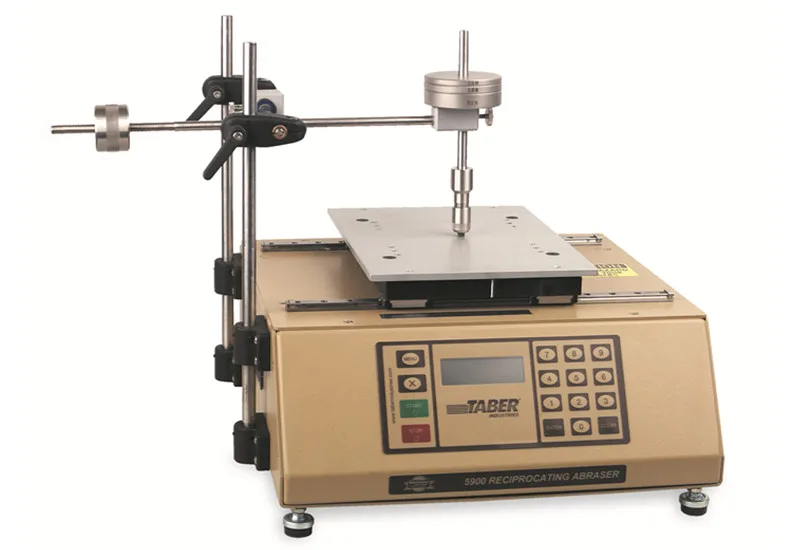
The TABER® Reciprocating Abraser 5900 is similar to the instrument described in ISO 1518. It is designed for flat surfaces. With optional attachments it can test a material's resistance to surface damage such as rubbing, scratching and marring.
Description
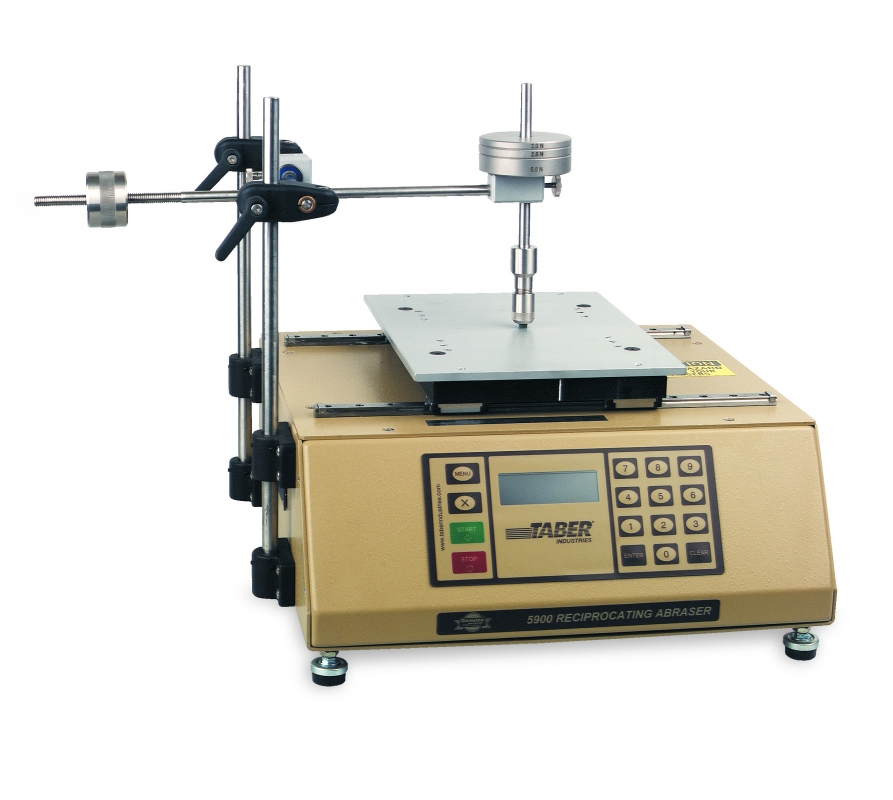
The abraser has a balanced arm that pivots on a height-adjustable crossbeam. A counterweight balances the arm so the test load is accurate and unaffected by the weight of attachments. At the end of the arm is a holder for the weights and test attachments. The sample table moves back and forth horizontally underneath.
Test parameters: stroke 6–155 mm, speed 3–75 cycles per minute, load 1–24 N. Weights of 1 N, 2 N, 2.5 N, 5 N, 10 N and 24 N are supplied, so the load can be tuned to each material.
Additional weights can be bought separately: 50 g, 100 g, 150 g, 200 g, 500 g, 1000 g, 2000 g, 2400 g and 5000 g. An optional weight support is also available that takes the disc weights from the 5750 Linear Abraser (10 g, 20 g, 50 g, 75 g, 100 g, 150 g or 250 g).
CS-10 and H-18 Wearaser® strips are supplied. They look like pencil erasers and are made of the same material as the abrading wheels.
The standard sample table measures 216 mm x 278 mm and is drilled to take sample clamps or the optional sample mounting plates. For most flat samples the clamps or the optional wide-slot mounting plate are enough. For flexible materials such as textiles, use the optional sample mounting plate. Slightly curved products can be held with the supplied clamps or a custom fixture.
Two more arms can be added to the instrument to run three tests at once.