
6160 Oscillating Sand Abraser
- Brand
- TABER
- Model
- 6160
- Origin
- USA
- Industries
- Lenses, coatings, phone screens
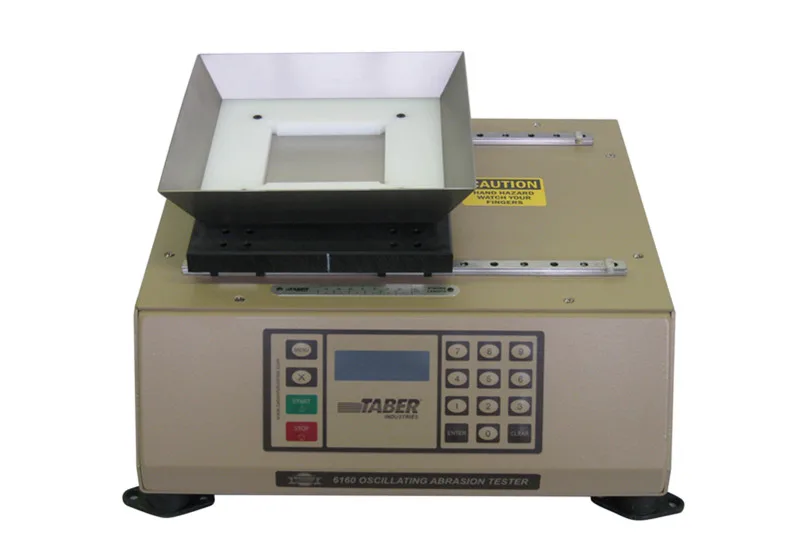
The TABER® Oscillating Abrasion Tester 6160 is an oscillating sand abraser, as described in ASTM F735 (Standard Test Method for Abrasion Resistance of Transparent Plastics and Coatings Using the Oscillating Sand Method). It determines the relative abrasion resistance of material surfaces. It was originally used for transparent materials and coatings for windows and lenses, but can also test organic coatings, plastics, metals and other materials.
Description
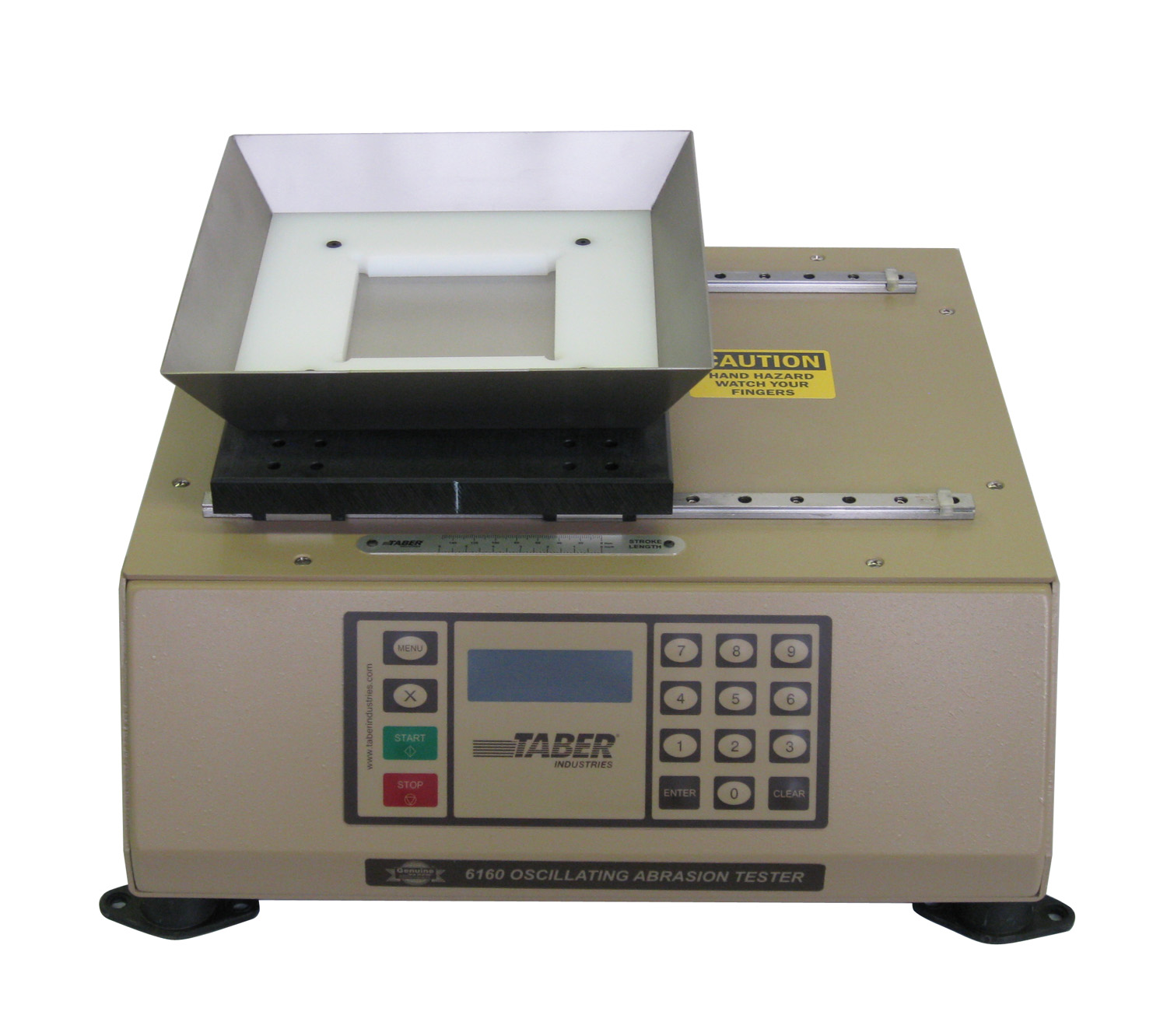
Rigid samples 100 mm square and under 12.5 mm thick are mounted in the bottom of a tray, flush with the bottom to within 1 mm.
The tray holds a standard abrasive medium, such as quartz sand or alumina, in an even layer, for example 12.5 mm deep. A fork-type drive moves the tray back and forth,
sending the abrasive rapidly across the tray. The oscillating abrasive produces a random scratch pattern on the sample surface that simulates everyday wear.
Parameters such as stroke (6.5–150 mm) and speed (100–200 cycles/min) can be adjusted. ASTM F735 specifies a 100 mm stroke at 300 strokes/min (150 cycles/min).
With custom sample holders, materials of various shapes can be tested. It is important to recognise that a curved sample surface changes the amount and pressure of abrasive in contact with it,
so that the test yields useful data. Strongly curved samples may affect the movement of the abrasive.
Optional accessories are available for the Bayer abrasion test on curved lenses.
Abrasive media
In December 2011, the supplier of the 4/10 abrasive described in section 6.1 of ASTM F735 was sold, and the new company no longer makes the product. In June 2017, ASTM Committee F07 on Aerospace and Aircraft approved a proposal to update the ASTM F735 abrasive to quartz sand, grade 6/9, which has been supplied since December 2011.
Besides quartz sand, possible media include zirconia, silicon carbide, alumina and glass beads. The size and shape of the abrasive are very important for repeatable results.
During a test the abrasive wears as its sharp edges rub against the sample and against each other. To ensure repeatability, use fresh abrasive for each test. Changing the abrasive after 300 cycles is also recommended.
Evaluation
For transparent samples, measure haze and light transmission with a haze meter, and record the change after a set number of cycles. The abrasion resistance of opaque materials is assessed visually or by weight loss.