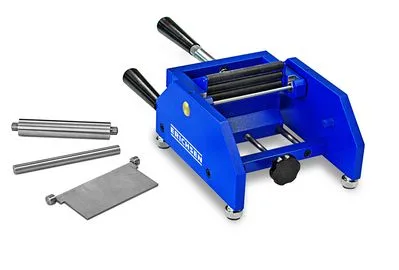
312 Conical Mandrel Bend Tester
- Brand
- ERICHSEN
- Model
- 312
- Origin
- Germany
- Industries
- Steel, coatings
Features
Bends coated metal panels over a conical mandrel to find where the coating cracks.
Product overview
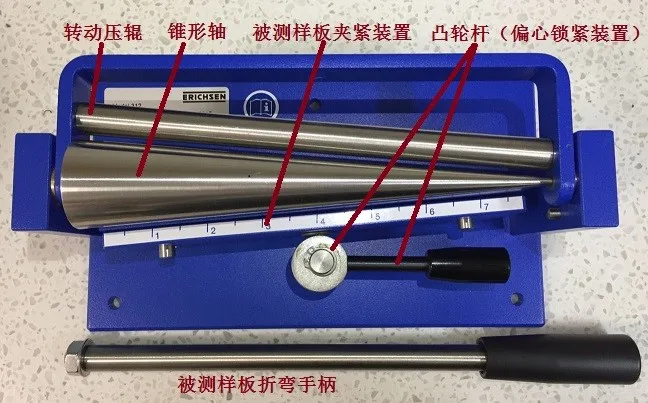
The ERICHSEN 312 Conical Mandrel Bend Tester is a compact, sturdy instrument with a painted steel base, suited to bench use. The conical mandrel and the rotating pressure roller parallel to it are made of stainless steel, and the clamp has a cam lever so that test panels can be changed quickly.
The conical mandrel bend test is a very widely used method, mainly for measuring how the flexibility and adhesion of a coating change under bending stress.
Technical data
Dimensions: 250 × 174 × 420 mm (L × W × H)
Net weight: approx. 5.6 kg
Panel thickness: 1/32" (0.79 mm)
Panel width: panels up to 190 mm wide
Mandrel range: 1/8 – 1½" (3.2 – 38.1 mm)
ERICHSEN 312
Conical Mandrel Bend Tester
ISO / EN ISO / ASTM D
Product overview
The ERICHSEN 312 Conical Mandrel Bend Tester is a compact, sturdy instrument with a painted steel base, suited to bench use. The conical mandrel and the rotating pressure roller parallel to it are made of stainless steel, and the clamp has a cam lever so that test panels can be changed quickly.
The conical mandrel bend test is a very widely used method, mainly for measuring how the flexibility and adhesion of a coating change under bending stress.
Applications
The ERICHSEN 312 is mainly used to determine the bending resistance (flexibility and adhesion) of paints and coatings applied to metal panels.
Standards:
ISO 6860
EN ISO 6860
ASTM D 522
Test principle
The 312 relies on the fact that metals (mainly steel) withstand bending better than coatings. After the coating has been applied to a metal panel and cured, the panel is bent to find the largest diameter of the conical mandrel at which the coating cracks or breaks.
Test procedure:
v Return the bending lever to the same end as the panel clamp; this opens the test window.
v Pass the test panel between the conical mandrel and the roller and insert it into the clamp.
v Slide the panel to the narrow end of the mandrel.
v Turn the cam lever to lock the panel; once it is fixed, the test can begin.
Notes:
1. Placing a sheet of paper between the sample and the roller avoids scratching sensitive paint surfaces.
2. During the test, turn the bending lever smoothly round the mandrel in 2–3 seconds to bend the panel.
3. Report the result as the distance from the narrow end of the mandrel to the crack, or as the mandrel diameter at the crack.
4. Mandrel diameters in inches can be found from the scale on the clamp and the table below.
Technical data
Dimensions: 250 × 174 × 420 mm (L × W × H)
Net weight: approx. 5.6 kg
Panel thickness: 1/32" (0.79 mm)
Panel width: panels up to 190 mm wide
Mandrel range: 1/8 – 1½" (3.2 – 38.1 mm)
Ordering guide
Ordering information | |
Order no. | Description |
0002.01.31 | Conical Mandrel Bend Tester 312. |