
The ERICHSEN 243 Flow Cup from Sinotime is designed for testing paints and inks: an important instrument for quick, simple viscosity measurement in the laboratory and in production. It is highly accurate for Newtonian liquids and suits low- to medium-viscosity fluids, but not high-viscosity substances such as pastes.
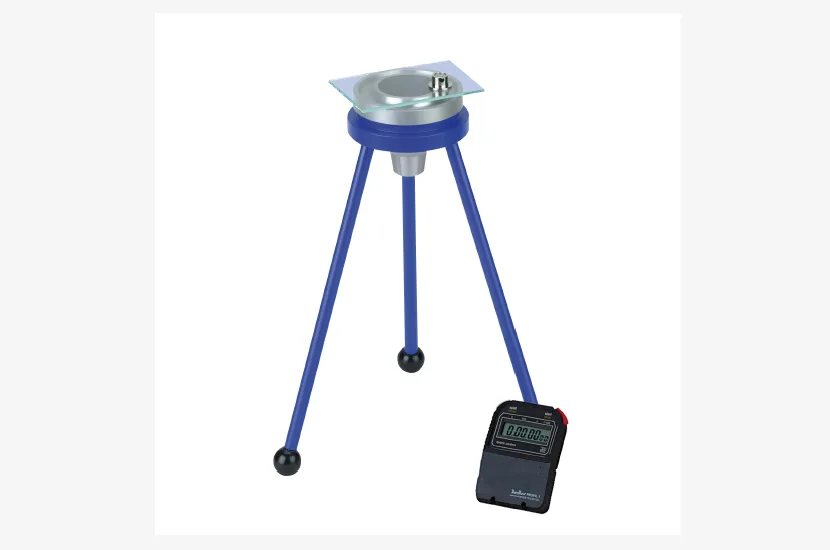
How the 243 Flow Cup measures
Viscosity is calculated from the time (in seconds) a precisely controlled volume of fluid takes to flow out of the cup's orifice.
The viscosity and flow of an ink are important for print quality. In environmentally friendly waterborne inks, flow and viscosity are closely linked: increasing an ink's viscosity reduces its flow, and vice versa. A thick ink is not necessarily a high-viscosity ink, and a high-viscosity ink is not necessarily thick; only for inks of the same viscosity does greater thickness mean poorer flow.
If flow is too low, the ink does not transfer smoothly and evenly during printing, giving light-to-dark variation across the same print and other ink faults. If flow is too high, the image does not transfer accurately, tones are indistinct, colours are weak and dull, and the ink also tends to cause scumming and streaks.
During printing, the viscosity and flow of security inks can be adjusted with ink modifiers, but never add cornflour to the ink to make prints dry faster. Quick-drying inks can be used for that instead.
Ink (printing ink) is an important printing material that reproduces images and text on a substrate by printing or inkjet. It contains main and auxiliary components, mixed evenly and milled repeatedly into a viscous colloidal fluid made up of binder (resin), pigments, fillers, additives and solvents. It is used for printing books and magazines, packaging, architectural decoration, electronic circuit boards and more. As demand grows, the range and output of inks keep expanding.
Inks fall into three main groups:
Relief inks: letterpress inks, coated-paper inks, rotary letterpress inks, flexographic inks and so on.
Gravure inks: engraved gravure inks, photogravure inks, UV-fluorescent security gravure inks, waterborne film laminating gravure inks, waterborne cigarette-pack gravure inks, paper gravure inks and so on.
Planographic inks: offset inks, web offset inks, sheet-fed offset inks, waterless offset inks, metal decorating inks, lithographic inks, collotype inks and so on.
Ink tests:
Physical properties: colour, gloss, fineness, viscosity, initial drying, tinting strength, adhesion, blocking resistance, flow, film drying.
Durability: UV ageing, xenon arc ageing, neutral or acetic salt spray, heat stability, lightfastness, resistance to liquids and so on.
Hazardous substances: phthalates, azo dyes, heavy metals and so on.
Ink test standards:
QB/T 2025-2013 Lithographic metal decorating inks
QB/T 2825-2006 Waterborne flexographic inks
QB/T 2024-2012 Gravure laminating inks for plastic films
QB/T 2993-2008 Erasable ink ballpoint pens and refills
QB/T 4538-2013 Waterborne heat-resistant flexographic pre-print inks
GB/T 18752-2002 Thermochromic security inks
GB/T 26394-2011 Waterborne film laminating gravure inks
Inks add colour and interest to life and are indispensable, so quality testing must not be careless. Ink quality determines whether printed colours are correct and stable. Ink testing controls colour quality mainly by testing hue, tinting strength and lightfastness, eliminating colour casts at the source. Test reports and related information can come from the supplier, or printers can have inks tested by a professional third-party laboratory.
For the 243 Flow Cup, follow Sinotime for more accurate coating tests. Sinotime specialises in surface testing instruments with a complete range. The European and American brands we represent are leaders in their field. As a national agent, Sinotime has offices in Beijing, Shanghai, Shenzhen and Hong Kong. Note: products not bought from Sinotime are not covered by our warranty. We hold certificates for the products we represent.