
The 503 Tri-Angle Glossmeter is used in the paints and coatings industry. So what are the key steps and properties in coatings testing?
1. The purpose of coatings analysis and testing
Coatings have many properties, and these determine their quality and uses. Many test methods have been developed to evaluate coatings from different angles, covering two main areas: testing the coating itself and testing the dried film.
2. Why coatings testing matters
Waterborne coatings
Analysis and testing are an indispensable part of making and using coatings. They are the main basis for setting product specifications and the concrete means of evaluating performance and quality. Tests provide data for formulation design and process conditions, and accurately reflect and control product quality. Test data also support basic research into the relationship between composition and performance, revealing problems with existing products and directions for improvement, and providing a basis for developing new products.
3. Common specifications in coatings analysis and testing
Physical properties of the coating include density and viscosity; optical properties of the film include gloss and colour; mechanical properties include hardness and flexibility. Weathering and chemical resistance are also very important measures of performance, and formulations often include additives such as UV absorbers to improve weathering.
4. Film adhesion test methods
Stone-effect paints
Film adhesion is the ability of the film to bond firmly to the surface it coats. Products with poor adhesion easily peel off and lose their protective and decorative effect. Adhesion test methods include the circle scribe, cross-cut, torque, scratch, tape and peel tests. The cross-cut test assesses a coating's resistance to separating from the substrate when a right-angled lattice pattern is cut through it to the substrate. The pull-off method measures the force needed to break the bond between coats, or between coating and substrate, by applying a uniform perpendicular tensile force to the bonded face at a specified rate.
5. Pencil hardness of the film
Film hardness is the firmness of the dried film and indicates how much damage it will suffer from friction and knocks. There are many ways to measure it; the pencil hardness method is the most common today. Pencils of known hardness grade are scratched across the film, and the film hardness is expressed as the pencil grade.
6. Measuring film thickness
Film thickness affects all of a film's properties, especially its physical and mechanical properties, so film properties must always be tested within a specified thickness range. There are many ways to measure thickness: on glass panels with a micrometer, on steel panels with a non-magnetic thickness gauge, and on plastic coatings with ultrasonic methods.
What are the advantages of Sinotime's Erichsen 503 Tri-Angle Glossmeter for coatings testing?
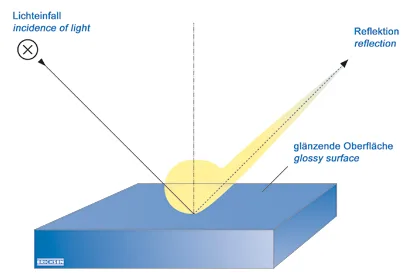
A compact, practical glossmeter with three measuring angles: 20° (high gloss), 60° (medium gloss) and 85° (low gloss), to DIN, ISO, ASTM, BS and NF standards. Certificate to DIN 67530. Data memory and statistics, simple two-button operation, printer and data transfer.
Coating tests:
① Protective/anti-corrosion properties: resistance to water, heat, low temperature, damp heat, salt spray, alkalis, oil, salt and so on.
② Mechanical properties: colour, thickness, curing time, drying time, adhesion, flexibility, bend test, tack, abrasion resistance, sandability, Shore hardness, rubber hardness, pencil hardness, pendulum hardness, dry heat resistance, scratch resistance, tensile properties, tear strength and so on.
③ Liquid properties: appearance, transparency, colour, viscosity, flow time, fineness, non-volatile content, hiding power, ash, consistency, flash point, acid value, density, saponification value, stability, solids content, particle size distribution, flow, solubility, hydroxyl value and so on.
④ Hazardous substances: lead, cadmium, hexavalent chromium, chromium, mercury, total lead, limits for specific harmful elements, VOC, residual monomers, metals, benzene, toluene, ethylbenzene and xylene, soluble harmful elements, chlorinated hydrocarbons, formaldehyde, antimony, phthalates, asbestos and so on.
Sinotime specialises in surface testing instruments with a complete range. The European and American brands we represent are leaders in their field. As a national agent, Sinotime has offices in Beijing, Shanghai, Shenzhen and Hong Kong. Note: products not bought from Sinotime are not covered by our warranty. We hold certificates for the products we represent.