
For a quality 296 Wet and Dry Film Thickness Gauge, choose Sinotime:
For dry films, it measures film thickness from the height difference between the coating and the substrate. For wet films, the probe is raised with the rotary knob and then lowered onto the wet film surface.
Complies with ISO 2808, ASTM D1005, BS 3900:C5, Rossmann
Application
All flat surfaces
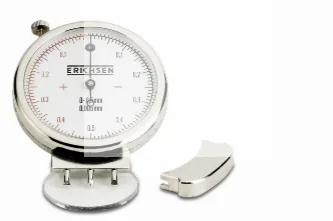
Test principle
Dry film thickness: as with the Model 233, the D value of a dry coating is the distance between a retractable test pin (1) and two feet (2) that rest on the coating surface.
Wet film thickness: the D value of a wet coating is measured by manually adjusting the test pin (1) so that it passes through the coating and rests on the substrate, again with two feet (2).
Design and function
The height difference (D) between the surface of a wet coating and the substrate is measured by manually adjusting the pin (1) and two feet (2) so that they pass through the coating and rest on the substrate.
Design and function
A knurled nut on top lets the pin move freely. The pin can be set below or above the feet.
Test procedure
Dry film thickness: after zeroing, choose a measuring point and carefully cut a hole just big enough for the test pin (about 3 mm in diameter), deep enough to expose the substrate without cutting into it. Place the gauge over the area so that the test pin touches the bare substrate; the dry film thickness can then be read directly from the dial in micrometres (µm). If the coating is soft, put razor blades under the feet to make it firmer and more accurate; measure the blade thickness beforehand.
Wet film thickness: first raise the test pin with the knurled nut until it reads 0.5 mm above the feet. Then place the gauge on the wet coating with the feet resting on the substrate, and lower the test pin slowly with the nut until it touches the coating surface. The thickness can be read directly.
Dry film thickness (µm) = wet film thickness (µm) × volume solids of the coating (%)
Wet film thickness is generally measured by applicators as a guide to how much coating to apply to achieve the intended dry film thickness.
There are generally two kinds of wet film gauge: wet film wheels and wet film combs. The advantage of a wet film gauge is that an incorrect film thickness can be checked and corrected while the coating is being applied. If the applicator knows the wet film thickness, multiplying it by the coating's volume solids gives an estimate of the dry film thickness.
Dry film thickness (µm) = wet film thickness (µm) × volume solids of the coating (%)
Actual coating consumption (kg) = (1 + α) × theoretical spreading rate (kg/m²) × area painted (m²) (α is the coating loss factor)
In practice, coating is always lost to some degree because of uneven surfaces, losses during application, ambient conditions such as wind, and the type of application tools. So α is not a constant but depends on all these factors. Typically α is 0.6–0.8 for airless spraying of flat surfaces, 0.8–1.0 for spraying complex surfaces, 0.3–0.4 for hand application on flat surfaces and 0.4–0.6 for hand application on complex surfaces.
Sinotime specialises in surface testing instruments with a complete range. The European and American brands we represent are leaders in their field. As a national agent, Sinotime has offices in Beijing, Shanghai, Shenzhen and Hong Kong. Note: products not bought from Sinotime are not covered by our warranty. We hold certificates for the products we represent.