
The Erichsen P.I.G. 455 Paint Inspection Gauge (thickness gauge) from Sinotime
Anyone who has worked in the used-car trade has heard of the paint gauge. As the name suggests, it is an instrument for checking paint film thickness.
A paint gauge is very simple to operate: hold it perpendicular against the car's surface and it measures the paint thickness automatically. But although the gauge is simple to use, inspecting a car is not so simple. Follow Sinotime Industrial Ltd for guidance on how to do it.
The Erichsen P.I.G. 455 Paint Inspection Gauge (thickness gauge) from Sinotime
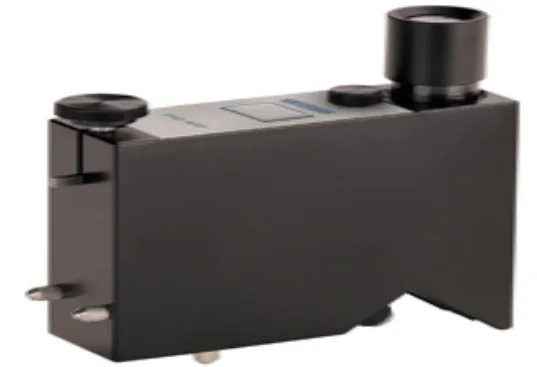
The ERICHSEN P.I.G. 455 Paint Inspection Gauge is a destructive dry film thickness gauge and the best solution for measuring coatings on flat non-metallic materials. The body is a black anodised aluminium block fitted with a 50× measuring microscope with a scale (2 mm divided into 100 parts). Besides measuring thickness, the microscope is also useful for inspecting other properties of the paint surface. It comes as standard with a No. 6 carbon steel cutter for a range of 2–200 µm, an LED light source, a light guide and a switch.
Some further background:
Why measure paint coating thickness?
Different paints do different jobs and need different coating thicknesses. For steel structures, a complete anti-corrosion paint system usually consists of several coats of anti-corrosion primer and topcoat. The coating thickness on steel must be right: too thick adds protection but reduces adhesion and mechanical properties and costs more; too thin easily leaves pinholes and other defects invisible to the eye, so the coating fails to seal out the environment and does not protect as intended.
Normally, steel structures need two coats of primer and two coats of topcoat. The total dry film thickness on steel members is generally 100–150 µm: at least 125 µm indoors and at least 150 µm outdoors, with a tolerance of 25 µm. By the sea, offshore or in strongly corrosive atmospheres, the total dry film can be increased to 200–220 µm. The coating system should be brushed or sprayed in no fewer than 4–5 coats. The thickness of each coat depends on the type of coating and the application method; brushing gives thicker coats than spraying. Normally each coat is about 35 µm for oil-based paints, 25 µm for synthetic resin paints and 15 µm for vinyl paints.
Coating thickness on steel structures should be measured with a paint coating thickness gauge and must meet the design specification and the Code for Acceptance of Construction Quality of Steel Structures (GB 50205).
Standard practice for measuring paint coating thickness:
To assess paint coating thickness accurately, measure as follows:
1. Coating thickness gauge
A paint coating thickness gauge non-destructively measures the thickness of non-magnetic coatings (such as aluminium, chrome, enamel, rubber or paint) on magnetic metal substrates (such as steel, iron, alloys and hard magnetic steel), and of non-conductive coatings (enamel, rubber, paint, plastics and so on) on non-magnetic metal substrates (such as copper, aluminium, zinc and tin).
2. Choosing measuring points
For fire-protective coatings on floor slabs and fire walls, take the area between two adjacent intersecting grid lines as one unit and measure one point per metre along its diagonal. For fire-protective coatings on beams and columns of all-steel frames, measure at regular intervals along the member.
For detailed operating steps for coating thickness gauges, see our article "How to use a coating thickness gauge".
3. Results
For floors and walls, measure at least 5 points in each chosen area; for beams and columns, measure 6 and 8 points respectively at each chosen location, and calculate the averages to the nearest 0.5 mm.
Sinotime specialises in surface testing instruments with a complete range. The European and American brands we represent are leaders in their field. As a national agent, Sinotime has offices in Beijing, Shanghai, Shenzhen and Hong Kong. Note: products not bought from Sinotime are not covered by our warranty. We hold certificates for the products we represent.