432 Gradient Oven
- Brand
- ERICHSEN
- Model
- 432
- Origin
- Germany
- Industries
- Coatings
Features
Simulates real production conditions, speeds up development and gives highly repeatable results.
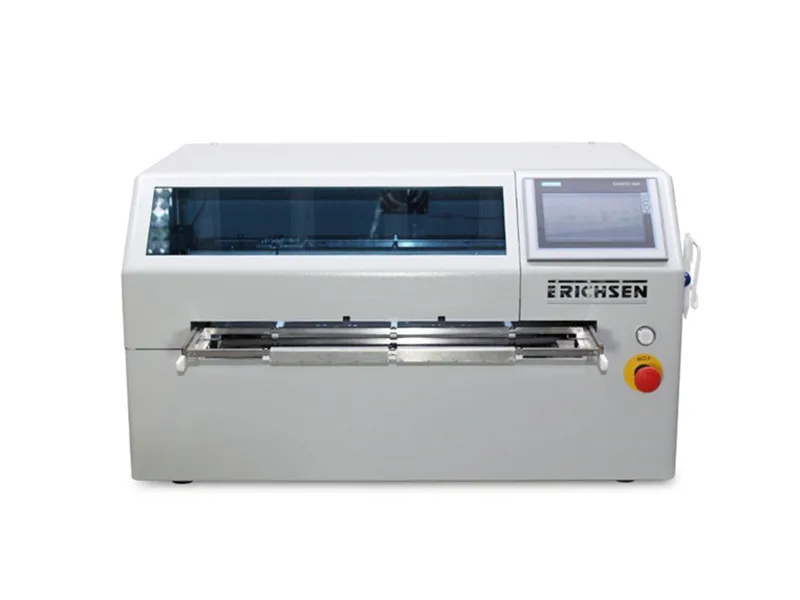
ERICHSEN 432 Gradient Oven (Germany)
Application
Acid rain, bird droppings, fuel, antifreeze and many other environmental factors damage car paint. Some substances are especially aggressive in summer and cause serious damage, so paint makers and car makers need to find out how different environments affect coatings.
For designing stoving systems and checking oven quality, it is very important to assess the temperature range and the maximum temperature, since the ingredients of a paint formulation (and so the inherent properties and quality of the product) change accordingly. Typical examples are yellowing of binders and colour changes of pigments.
For industrial stoving, precise control of the stoving process is vital to reach and maintain the specified quality. For various reasons, real conditions do not always match the intended settings, and in the worst case this can lead to high reject rates.
The 432 Gradient Oven makes it possible to optimise the process where products have problems. The actual temperature profile of a production oven can be measured beforehand with an oven temperature logger and then simulated closely with a suitable temperature gradient – an almost 1:1 simulation of the production oven, saving time and money compared with pilot-scale equipment.
How it works
The 432 Gradient Oven is used to assess the stoving and drying behaviour of products such as paints, powder coatings, resins and plastics. Heating rate, stoving temperature and time can be programmed to simulate real production. The gradient oven helps speed up product development and saves time and money. With its excellent repeatability, it can determine critical limits very precisely.
The maximum test temperature for coatings is 320 °C. A dual applicator applies two different coatings to one panel at once, making comparison easy and saving time and material. In stoving quality control, gradient oven tests are much faster than tests in conventional convection ovens.
In a standard test, five different chemicals can be tested on one panel: for example sulphuric acid to simulate polluted air and acid rain, sodium hydroxide for car cleaning agents, pancreatin (bird droppings), brake fluid and tree resin. Liquid paints are applied with a film applicator and drawdown device; panels can also be spray-coated after masking the edges and back.
Powder coatings can be applied electrostatically after masking the panel or covering it with magnetic strips. After coating, the panels are stoved under the specified process conditions.
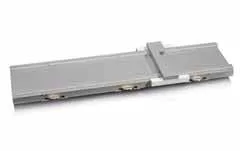
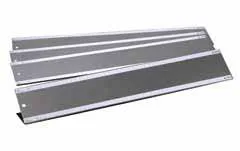
Drawdown device Panel (coated)
About 0.05 ml of each reagent is placed on the panel with a pipette at intervals, 2–3 cm apart. The gradient oven is then programmed with a linear gradient from 35 °C to 80 °C.
To evaluate the panel, it is first stoved at high temperature, then rinsed under running water, dried and assessed visually. Assess after 1 hour, and again after 24 hours to check for further etching.
Record the temperature at which the appearance first starts to change or the coating is damaged.
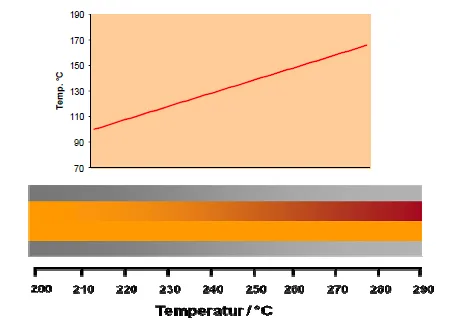
The 432 Gradient Oven has a microprocessor-controlled heating platform with 45 insulated heating elements, producing a perfectly linear temperature gradient or step gradients.
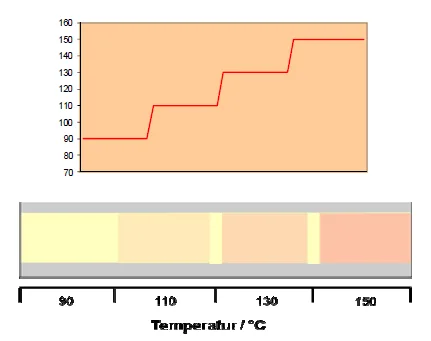
"Step gradient": three step settings automatically divide the panel into 2, 3 or 4 equal sections (temperature levels). Some heating elements between the levels are not heated so that each level holds its set temperature; these elements are recorded in the report, or shown with a set temperature of 23 °C.
The 432 Gradient Oven is a bench-top laboratory instrument for use in non-hazardous areas at normal ambient temperature (about 18–25 °C) and humidity (<85%).
It is operated through menus in English, French or German, with a built-in alphanumeric keypad. All functions are shown on the display in the corresponding menus.
The gradient oven meets safety class 1. Every oven undergoes strict quality testing to DIN VDE 0700 Part 1.
Technical data
Voltage: 230 V, 50/60 Hz
Power: 3400 VA
Heated area: 520 × 100 mm
Test area: 500 × 70 mm
Heating elements: 45
Pressure platform: automatic panel in/out feed (16 kp)
Linear gradient: max. 100 °C difference between 30 and 250 (320) °C
Step gradient: 2, 3 or 4 steps; max. 50 °C between steps
Heating rate: 2–30 °C/min, programmable
Stoving time: set in minutes and seconds
Memory: up to 10 step programs
Accuracy: heating element control < ± 2 °C
Surface temperature of a 0.8 mm panel over heating elements 3 to 43:
up to 200 °C ± 2 °C
up to 250 °C ± 3 °C
up to 320 °C ± 5 °C
measured under specified test conditions
Dimensions: 465 × 720 × 595 mm
Weight: 50 kg